
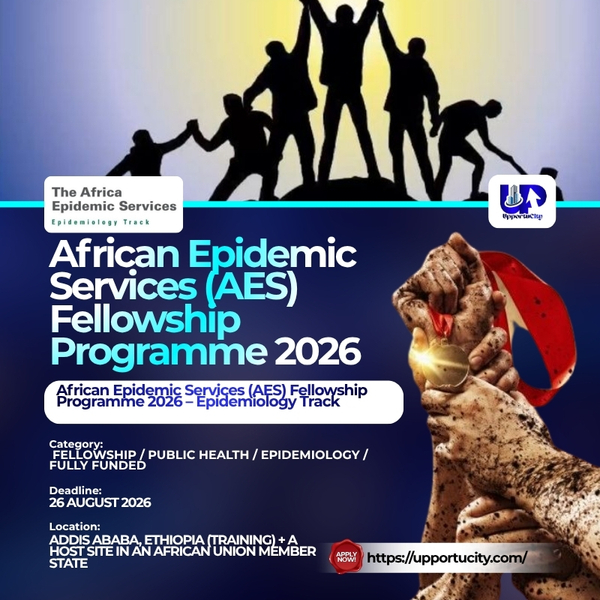
Africa CDC African Epidemic Services (AES) Epidemiology Fellowship 2026: Fully Funded Two-Year Public Health Fellowship
Posted By
Agada Victory Iko-ojo
Company
N/A
Location
Addis Ababa, Ethiopia
Table of Contents
Africa CDC African Epidemic Services (AES) Epidemiology Fellowship 2026
Applications are now open for the Africa CDC African Epidemic Services (AES) Epidemiology Fellowship 2026, a fully funded two-year training programme designed to equip Africa's next generation of field epidemiologists with the knowledge, practical experience, and leadership skills needed to prevent, detect, and respond to disease outbreaks across the continent.
Hosted by the Africa Centres for Disease Control and Prevention (Africa CDC) under the African Union (AU), the fellowship targets early- to mid-career public health professionals committed to strengthening Africa's disease surveillance and emergency response systems through science, data, and evidence-based public health practice.
Successful applicants will receive comprehensive training, mentorship, practical field experience, financial support, and the opportunity to work alongside public health experts in African Union Member States.
Application Deadline: 26 August 2026
PROGRAMME OVERVIEW
- Programme: African Epidemic Services (AES) Epidemiology Fellowship 2026
- Organiser: Africa Centres for Disease Control and Prevention (Africa CDC)
- Host Organisation: African Union (AU)
- Programme Type: Full-Time Fellowship
- Funding: Fully Funded
- Duration: Two Years
- Training Location: Addis Ababa, Ethiopia, and host sites across African Union Member States
- Eligible Applicants: Public health professionals from African Union Member States
- Programme Start: October 2026
- Application Deadline: 26 August 2026
ABOUT AFRICA CDC
The Africa Centres for Disease Control and Prevention (Africa CDC) is the African Union's specialised public health agency responsible for strengthening disease prevention, surveillance, preparedness, and emergency response across the continent.
To address the growing need for a skilled health workforce, Africa CDC launched the Africa Health Workforce Compact in 2025. The initiative supports the African Union's Agenda 2063 by investing in the training, retention, and development of health professionals capable of responding to current and future public health challenges.
One of the key programmes under this initiative is the African Epidemic Services (AES) Programme, which focuses on developing highly skilled professionals in epidemiology, laboratory leadership, and public health informatics.
ABOUT THE FELLOWSHIP
The African Epidemic Services (AES) Programme is Africa CDC's flagship workforce development initiative designed to strengthen disease prevention and outbreak response capacity across Africa.
The programme is divided into three specialised tracks:
- Epidemiology
- Laboratory Leadership Fellowship
- Public Health Informatics
This call specifically relates to the Epidemiology Track, which prepares public health professionals to investigate disease outbreaks, analyse health data, strengthen surveillance systems, and support evidence-based decision-making within African health systems.
The fellowship combines classroom learning with extensive field experience, enabling participants to apply their knowledge in real public health settings.
WHAT HAPPENS DURING THE TWO-YEAR FELLOWSHIP?
The fellowship follows a competency-based learning model that combines theoretical instruction with practical field experience.
Phase One: Three-Month Residential Training
The programme begins with an intensive three-month in-person training in Addis Ababa, Ethiopia.
During this phase, fellows receive advanced instruction in:
- Applied epidemiology
- Disease surveillance
- Outbreak investigation
- Public health data analysis
- Biostatistics
- Scientific communication
- Evidence-based decision-making
- Emergency preparedness and response
The classroom training provides the technical foundation needed before participants move into field placements.
Phase Two: Twenty-One Months of Field Placement
Following the residential training, fellows spend 21 months working in an approved host institution within an African Union Member State.
During the placement, fellows gain practical experience by participating in Core Activities of Learning (CALs), including:
- Disease surveillance and monitoring.
- Outbreak investigation and response.
- Public health data collection and analysis.
- Evaluation of surveillance systems.
- Risk assessment.
- Scientific reporting and presentations.
- Supporting national disease control programmes.
Each fellow is assigned an experienced supervisor or mentor who provides technical guidance throughout the programme.
This practical approach allows participants to develop real-world experience while contributing directly to strengthening public health systems in Africa.
FELLOWSHIP BENEFITS
Africa CDC will fully support successful applicants throughout the programme.
Benefits include:
- Full sponsorship for the entire two-year fellowship.
- Three months of residential training in Addis Ababa, Ethiopia.
- Twenty-one months of supervised field placement.
- Monthly stipend.
- International and local travel support.
- Health insurance.
- Laptop and other required hardware.
- Software and learning resources.
- Mentorship from experienced public health professionals.
- Practical experience in disease surveillance and outbreak response.
- Access to a continental network of public health experts.
WHO CAN APPLY?
Applicants must:
- Be citizens of an African Union Member State.
- Be under the age of 35 years, in line with the African Union's definition of youth.
- Be currently employed in an African country.
- Obtain official permission from their employing government institution to participate in the fellowship.
- Have a guarantee of returning to their position after completing the programme.
- Hold a Bachelor's or Master's degree in:
- Human Medicine
- Nursing
- Veterinary Medicine
- Public Health
- Environmental Sciences
- One Health
- Or another related field.
- Have completed coursework in epidemiology, quantitative research methods, and biostatistics.
- Have at least three years of post-graduate public health work experience.
- Demonstrate the ability to prepare scientific reports, conference presentations, and technical publications.
- Be proficient in at least one African Union official language (English, French, Arabic, Portuguese, Spanish, or Kiswahili).
Knowledge of an additional AU official language is considered an advantage.
Note: Graduates and fellows of Advanced Field Epidemiology Training Programmes (Advanced FETP) are not eligible to apply.
REQUIRED APPLICATION DOCUMENTS
Applicants must submit:
- A valid passport from an African Union Member State.
- An official support letter from their government employer granting permission to attend the two-year fellowship and guaranteeing reinstatement after completion.
- Two professional letters of recommendation.
- Degree certificate(s) and academic transcripts.
- Curriculum Vitae using the official African Union CV template.
- A motivation statement (maximum 500 words) explaining:
- Why they are applying.
- Why they are suitable for the programme.
- How the training will benefit their country.
- Optional evidence of additional relevant qualifications.
Only complete applications submitted through the official online portal will be considered.
SELECTION CRITERIA
Applicants will be assessed based on:
- Academic qualifications.
- Professional public health experience.
- Knowledge of epidemiology and biostatistics.
- Leadership potential.
- Commitment to strengthening Africa's public health systems.
- Quality of the motivation statement.
- Employer support.
- Overall suitability for the fellowship.
Africa CDC also promotes gender equity, inclusivity, and broad geographical representation across African Union Member States during the selection process.
HOW TO APPLY
Interested applicants should complete the official online application form and upload all required supporting documents before the application deadline.
Applicants are encouraged to prepare their recommendation letters, employer approval letter, academic documents, and motivation statement well before submission to avoid delays.
Application Deadline: 26 August 2026
Programme Start Date: October 2026
Similar Opportunities

Heroes of Tomorrow: UN SDG Action Awards 2026 | Global Award & Fellowship Opportunity
Heroes of Tomorrow: UN SDG Action Awards 2026 | Global Award & Fellowship Opportunity Appli...
L’Oréal-UNESCO For Women in Science Sub-Saharan Africa Programme 2026 | Research Grant & Fellowship for African Women Scientists
L’Oréal-UNESCO For Women in Science Sub-Saharan Africa Programme 2026 | Research Grant & Fell...

Harry Evans Global Fellowship 2027 | Durham University
Harry Evans Global Fellowship 2027 | Durham UniversityThe Harry Evans Global Fellowship 2027 is an i...
2026 Western Union Foundation Fellowship Program (Global)
2026 Western Union Foundation Fellowship Program (Global)The Western Union Foundation Fellowship Pro...

Lagos Business School Young Talents Programme 2026
Lagos Business School Young Talents Programme 2026 OverviewThe Lagos Business School (LBS) Youn...
OBEL Teaching Fellowship Program 2026
OBEL Teaching Fellowship Program 2026 🎓OverviewThe OBEL Teaching Fellowship Program 2026 is a glo...
Deadline
Always Open
Join Our Global Community
Connect with thousands of other ambitious individuals and get instant updates on new opportunities.